agora-protocol
Agora
Propose, vote, veto, and quorum semantics for multi-agent systems — layered on top of MCP and A2A without changing either spec.
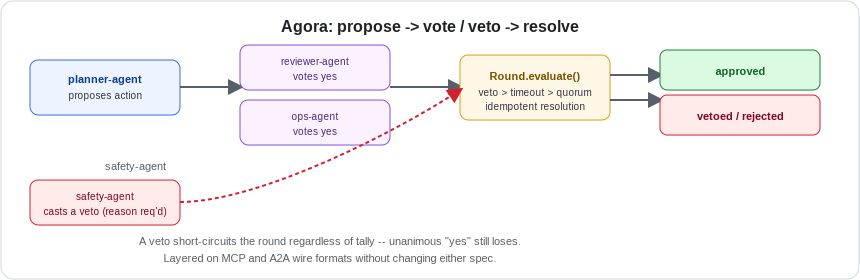
What it does
A 2026 protocol analysis, Governance Gaps in Agent Interoperability Protocols, looked at MCP, A2A, ACP, ANP, and ERC-8004 and found that voting and dissent preservation are absent from all five. None of them define a quorum, a preference-aggregation rule, or a way to record that a proposal was rejected and why.
Agora is a reference implementation of those missing primitives: a small, dependency-free state machine for propose, then vote or veto, then resolve. Reference adapters carry that deliberation over real A2A messages and real MCP tool calls, so you keep the protocols you already run.
- The core has no I/O and no protocol knowledge. Adapters only translate messages.
- A veto is a distinct outcome and overrides the tally, including a unanimous yes.
- Ties resolve to rejected. Fraction quorum is measured against registered voters.
- Resolution is idempotent. A timeout stays its own outcome and keeps the partial tally.
Install
npm install agora-protocolUsage
Open a round, collect votes, and resolve it:
import { Round } from "agora-protocol";

const round = Round.propose({
  id: "deploy-2026-09-15",
  proposerId: "planner-agent",
  action: { type: "deploy", service: "checkout-api", version: "4.2.0" },
  voters: ["planner-agent", "reviewer-agent", "ops-agent"],
  quorum: { type: "fraction", value: 2 / 3 },
});

round.castVote({ agentId: "planner-agent", choice: "yes" });
round.castVote({ agentId: "reviewer-agent", choice: "yes" });

const resolution = round.evaluate();
// { outcome: "approved", tally: {...}, resolvedAt: ... }
A registered vetoer can stop the round no matter how the votes add up:
round.castVeto({
  agentId: "safety-agent",
  reason: "no confirmed backup exists for this bucket",
});

round.evaluate();
// { outcome: "vetoed", veto: {...}, resolvedAt: ... }
The annotated demo in the repository runs both scenarios and prints the wire messages:
npx tsx examples/demo.tsLinks
- RepositorySource, issues, and the annotated demo
- npmagora-protocol package
- Research noteGovernance Gaps in Agent Interoperability Protocols
- Model Context ProtocolMCP, which the adapter speaks without a spec change
- Agent2AgentA2A, which the adapter speaks without a spec change
- MIT licenseFree to use