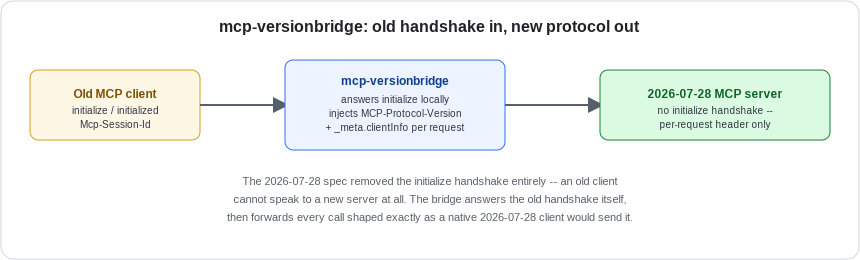
What it does
The 2026-07-28 MCP specification removed the initialize/initialized handshake and the Mcp-Session-Id header. Older clients (2024-11-05, 2025-03-26, 2025-06-18) still negotiate one protocol version for the whole session. A 2026-07-28 server never implements initialize, so those clients cannot talk to it.
mcp-versionbridge is a small HTTP proxy. It looks like an old-style MCP server to the client, and talks to a real 2026-07-28 server behind it.
- The client sends
initializeas usual. The bridge answers it locally — it is never forwarded — and returns anMcp-Session-Idthe client will echo back. - Later requests are forwarded with
MCP-Protocol-Versionset andparams._meta["io.modelcontextprotocol/clientInfo"]merged in, which is what a native 2026-07-28 client would send. - Responses are relayed back unchanged.
Version 1 bridges an old client to a new server over HTTP. The reverse direction, stdio, and server/discover capability negotiation are not in this version.
Install
npm install mcp-versionbridgeUsage
import { startVersionBridge } from "mcp-versionbridge";

const bridge = await startVersionBridge({
  newServerUrl: "https://my-2026-07-28-server.example.com/mcp",
});

console.log(`Point your old MCP client at ${bridge.url} instead of the real server.`);

// later
await bridge.stop();
The annotated demo runs a fixture 2026-07-28 server and a real old-style handshake, and prints what crosses the wire:
npx tsx examples/demo.ts